

how to find slope with one point
 Download Article
Download Article
The slope of a line is a measure of how fast it is changing. This can be for a straight line -- where the slope tells you exactly how far up (positive slope) or down (negative slope) a line goes while it goes how far across. Slope can also be used for a line tangent to a curve. Or, it can be for a curved line when doing Calculus, where slope is also known as the "derivative" of a function. Either way, think of slope simply as the "rate of change" of a graph: if you make the variable "x" bigger, at what rate does "y" change? That is a way to see slope as a cause and an effect event.
-
1
Use slope to determine how steep, and in what direction (upward or downward), a line goes. Finding the slope of a line is easy, as long as you have or can setup a linear equation. This method works if and only if:
-
2
Find the number in front of the x, usually written as "m," to determine slope. If your equation is already in the right form, , then simply pick the number in the "m" position (but if there is no number written in front of x then the slope is 1). That is your slope! Note that this number, m, is always multiplied by the variable, in this case an "x." Check the following examples:
-
3
Reorganize the equation so one variable is isolated if the slope isn't apparent. You can add, subtract, multiply, and more to isolate a variable, usually the "y." Just remember that, whatever you do to one side of the equal sign (like add 3) you must do to the other side as well. Your final goal is an equation similar to . For example:

-
1
Use a graph and two points to find slope without the equation handy. If you've got a graph and a line, but no equation, you can still find the slope with ease. All you need are two points on the line, which you plug into the equation . While finding the slope, keep in mind the following information to help you check if you're on the right track:
- Positive slopes go higher the further right you go.
- Negative slopes go lower the further right you go.
- Bigger slopes are steeper lines. Small slopes are always more gradual.
- Perfectly horizontal lines have a slope of zero.
- Perfectly vertical lines do not have a slope at all. Their slope is "undefined."[4]
-
2
Find two points, putting them in simple (x,y) form. Use the graph (or the test question) to find the x and y coordinates of two points on the graph. They can be any two points that the line crosses through. For an example, assume that the line in this method goes through (2,4) and (6,6).[5]
- In each pair, the x coordinate is the first number, the y coordinate comes after the comma.
- Each x coordinate on a line has an associated y coordinate.
-
3
Label your points x1, y1, x2, y2, keeping each point with its pair. Continuing our first example, with the points (2,4) and (6,6), label the x and y coordinates of each point. You should end up with:
- x1: 2
- y1: 4
- x2: 6
- y2: 6[6]
-
4
Plug your points into the "Point-Slope Formula" to get your slope. The following formula is used to find slope using any two points on a straight line: . Simply plug in your four points and simplify:
-
5
Understand how the Point-Slope Formula works. The slope of a line is "Rise over Run:" how much the line goes up divided by how much the line "runs" to the right. The "rise" of the line is the difference between the y-values (remember, the Y-axis goes up and down), and the "run" of the line is the difference between the x-values (and the X-axis goes left and right).
-
6
Recognize other ways you may be tested to find slope. The equation of the slope is . This may also be shown using the Greek letter "Δ", called "delta", meaning "difference of". Slope can also be shown as Δy/Δx, meaning "difference of y / difference of x:" this is the same exact question as "find the slope between

-
1
Review how to take a variety of derivatives from common functions. Derivatives give you the rate of change (or slope) at a single point on a line. The line can be curved or straight -- it doesn't matter. Think of it as how much the line is changing at any time, instead of the slope of the entire line. How you take derivatives changes depending on the type of function you have, so review how to take common derivatives before moving on.
- Review taking derivatives here
- The most simple derivatives, those for basic polynomial equations, are easy to find using a simple shortcut. This will be used for the rest of the method.
-
2
Understand what questions are asking for a slope using derivatives. You will not always be asked to explicitly find the derivative or slope of a curve. You might also be asked for the "rate of change at point (x,y). You could be asked for an equation for the slope of the graph, which simply means you need to take the derivative. Finally, you may be asked for "the slope of the tangent line at (x,y)." This, once again, just wants the slope of the curve at a specific point, (x,y).
-
3
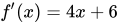
Take the derivative of your function. You don't even really need you graph, just the function or equation for your graph. For this example, use the function from earlier, . Following the methods outlined here, take the derivative of this simple function.
- Derivative:
-
4
Plug in your point to the derivative equation to get your slope. The differential of a function will tell you the slope of the function at a given point. In other words, f'(x) is slope of the function at any point (x,f(x)) So, for the practice problem:
-
5
Check your point against a graph whenever possible. Know that not all points in calculus will have a slope. Calculus gets into complex equations and difficult graphs, and not all points will have a slope, or even exist on every graph. Whenever possible, use a graphing calculator to check the slope of your graph. If you can't, draw the tangent line using your point and the slope (remember -- "rise over run") and note if it looks like it could be correct.
- Tangent lines are just lines with the exact same slope as your point on the curve. To draw one, go up (positive) or down (negative) your slope (in the case of the example, 22 points up). Then move over one and draw a point. Connect the dots, (4,2) and (26,3) for your line.

Add New Question
-
Question
What is the slope for the equation y=1?

The graph of y=1 is a straight, horizontal line, meaning that it does not rise or fall as it moves left or right. Its slope is therefore zero.
-
Question
What if the equation is like x+y=0 or x-y=0?

That's no problem. When x+y=0, y=-x. In this case the slope is -1. On the other hand, when x-y=0, y=x. Here the slope is +1.
-
Question
What's the difference between a slope = 0 and slope = undefined?
A zero slope is a horizontal line (parallel to the x-axis), and an undefined slope is a vertical line (parallel to the y-axis).
-
Question
Slope of a line 2x - y +9?
If the equation is 2x - y + 9 = 0, re-write it as y = 2x + 9. Once the equation is written in that form, the slope is seen as the coefficient of the independent variable (x in this case). So the slope is 2.
-
Question
How do I find the slope given a single point on a straight line?
If all you're given are the coordinates of a single point on a line, you cannot find a line's slope. You would need the coordinates of at least one more point.
-
Question
How do I find the slope in a word problem?
You would have to write an equation that reflects the conditions stated in the word problem. If you can write it in (or change it to) the form y = mx + b, the slope will be the x-coefficient (m).
-
Question
So is the slope of y=-2 .-2?

No. y = -2 is graphed as a horizontal line, meaning its slope is zero. Put another way, there is no x-term in the equation y = -2, meaning that the x-coefficient is zero. The x-coefficient is also the slope.
-
Question
How do I find the equation of a vertical line containing the point (2,5)?

Its equation is x=2.
-
Question
How would I find the slope of the line y = 4?
Any line whose equation is y = k (where k is any constant) will be horizontal (that is, parallel to the x-axis) and therefore will have a slope of zero. Another way of explaining it is to view y = 4 in the slope-intercept form: y = mx + b, where m (the slope) is zero (and b is 4).
-
Question
How do I find the slope intercept equation using only one set of points?
If you mean that the only information given is one point on the line, that's not enough information to define a line. You must have at least two points to define a straight line, or you must know one point and the slope.


Show more answers
Ask a Question
200 characters left
Include your email address to get a message when this question is answered.
Submit
Video
Thanks for submitting a tip for review!
About This Article
Article SummaryX
To find the slope of a linear equation, start by rearranging the given equation into slope-intercept form, which is y = mx + b. In slope-intercept form, "m" is the slope and "b" is the y-intercept. The slope of the line is whatever number is multiplied on the "x" variable, so just solve the equation for "x" to figure out the slope! For tips on finding the slope when you're given two points on a graph, read on!
Did this summary help you?
Thanks to all authors for creating a page that has been read 397,310 times.
Did this article help you?
how to find slope with one point
Source: https://www.wikihow.com/Find-the-Slope-of-an-Equation
Posted by: dillopith1974.blogspot.com
0 Response to "how to find slope with one point"
Post a Comment